Key points
The Rnest project illustrates Numendo’s ability to help clients translate complex technologies into concrete, user-friendly, and accessible solutions. Through close collaborative development blending technical expertise with UX sensibility, La mètis now possesses a modern, collaborative, and multilingual SaaS platform that enhances the value of its strategic offering and boosts the impact of its missions for clients.
4
Numendo experts in total
14
months of development
introduction
Delivering strategic intelligence through AI: La mètis’ successful bet with Numendo
La mètis is a strategic intelligence company. It produces white notes while minimizing confirmation bias as much as possible. To achieve this, its analyses are based on a rigorous protocol for cross-checking Internet sources in several languages. La mètis team members avoid relying on prior knowledge, whether from personal experience or from the training of generative AI algorithms (LLMs).
La mètis is a strategic intelligence company. It produces white notes while minimizing confirmation bias as much as possible. To achieve this, its analyses are based on a rigorous protocol for cross-checking Internet sources in several languages. La mètis team members avoid relying on prior knowledge, whether from personal experience or from the training of generative AI algorithms (LLMs).
context
Since its creation, the company has carried out intensive research and development to explore the deep web. The objective is to “see what others do not see,” in order to provide clients with a strategic advantage or help them avoid a strategic surprise.
The successes achieved in exploring the deep web encouraged the company to create a first software product POC. The objective was to amplify and extend clients’ strategic intelligence capabilities through SaaS software.
The first version of the POC validated the unique value of the data collected by La mètis on the deep web. Users quickly began requesting artificial intelligence tools to make it easier to leverage this data, which could not be found by other means.
To meet this demand, La mètis designed Rnest, an AI capable of automatically cross-checking information available on the Internet.
In-depth UX/UI design work was carried out so that users could use Rnest before, during, and after their research with ChatGPT, Gemini, Claude, or Perplexity. Rnest helps them improve their questioning and verify that agentic AI does not omit key strategic intelligence elements.
The successes achieved in exploring the deep web encouraged the company to create a first software product POC. The objective was to amplify and extend clients’ strategic intelligence capabilities through SaaS software.
The first version of the POC validated the unique value of the data collected by La mètis on the deep web. Users quickly began requesting artificial intelligence tools to make it easier to leverage this data, which could not be found by other means.
To meet this demand, La mètis designed Rnest, an AI capable of automatically cross-checking information available on the Internet.
In-depth UX/UI design work was carried out so that users could use Rnest before, during, and after their research with ChatGPT, Gemini, Claude, or Perplexity. Rnest helps them improve their questioning and verify that agentic AI does not omit key strategic intelligence elements.
Numendo met the design team’s UX/UI specifications down to the finest detail, delivering robust development that perfectly matches our clients’ high standards. Their support, from development through to onboarding our teams, empowers us to be fully autonomous today, relying on a solution that is both powerful and user-friendly.
numendo’s support
It was in this context that La mètis asked Numendo to develop its SaaS software product. After an initial UX/UI phase carried out upstream, our teams handled the development and integration of the mockups while building a sustainable and scalable architecture.
The project lasted more than a year, with an initial phase of five to six months dedicated to developing the web interface. A team composed of a project manager and three developers led the first stages, before gradually handing over to a single developer responsible for further developments and knowledge transfer to La mètis’ internal teams.
The project lasted more than a year, with an initial phase of five to six months dedicated to developing the web interface. A team composed of a project manager and three developers led the first stages, before gradually handing over to a single developer responsible for further developments and knowledge transfer to La mètis’ internal teams.
Solid experience
A solid and scalable technical foundation
The first version already relied on a GraphQL + MongoDB combination, with a React frontend.
For V2, Numendo supported La mètis in adopting a new architecture:
• Frontend: React
• Backend: Node.js with the AdonisJS framework
• Database: MongoDB, which connects the application to the Rnest search engine
• API: GraphQL, already in place and retained for its advantages
Particular attention was paid to design and visual consistency through the integration of a reusable component library, built in Storybook and aligned with the existing design system.
Finally, the platform was designed to meet the needs of an international client base, with multilingual support (French, English, Chinese, Russian, Arabic, and others under development).
The first version already relied on a GraphQL + MongoDB combination, with a React frontend.
For V2, Numendo supported La mètis in adopting a new architecture:
• Frontend: React
• Backend: Node.js with the AdonisJS framework
• Database: MongoDB, which connects the application to the Rnest search engine
• API: GraphQL, already in place and retained for its advantages
Particular attention was paid to design and visual consistency through the integration of a reusable component library, built in Storybook and aligned with the existing design system.
Finally, the platform was designed to meet the needs of an international client base, with multilingual support (French, English, Chinese, Russian, Arabic, and others under development).
A redesigned experience
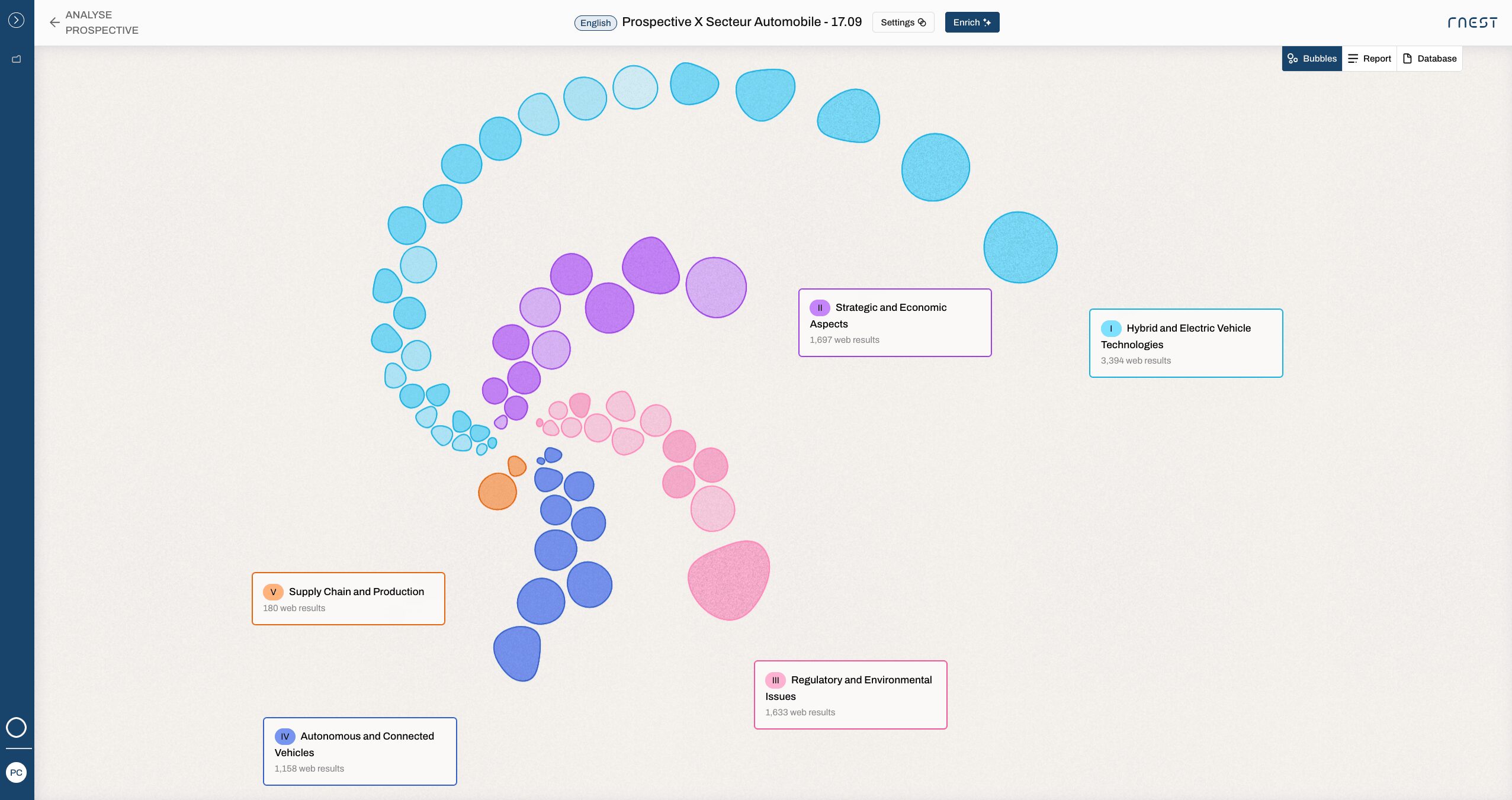
Rnest draws the user’s attention to events, concepts, issues, people, or organizations that are essential to understanding a topic.
Users can scan the key points raised by Rnest in just a few minutes, in three forms:
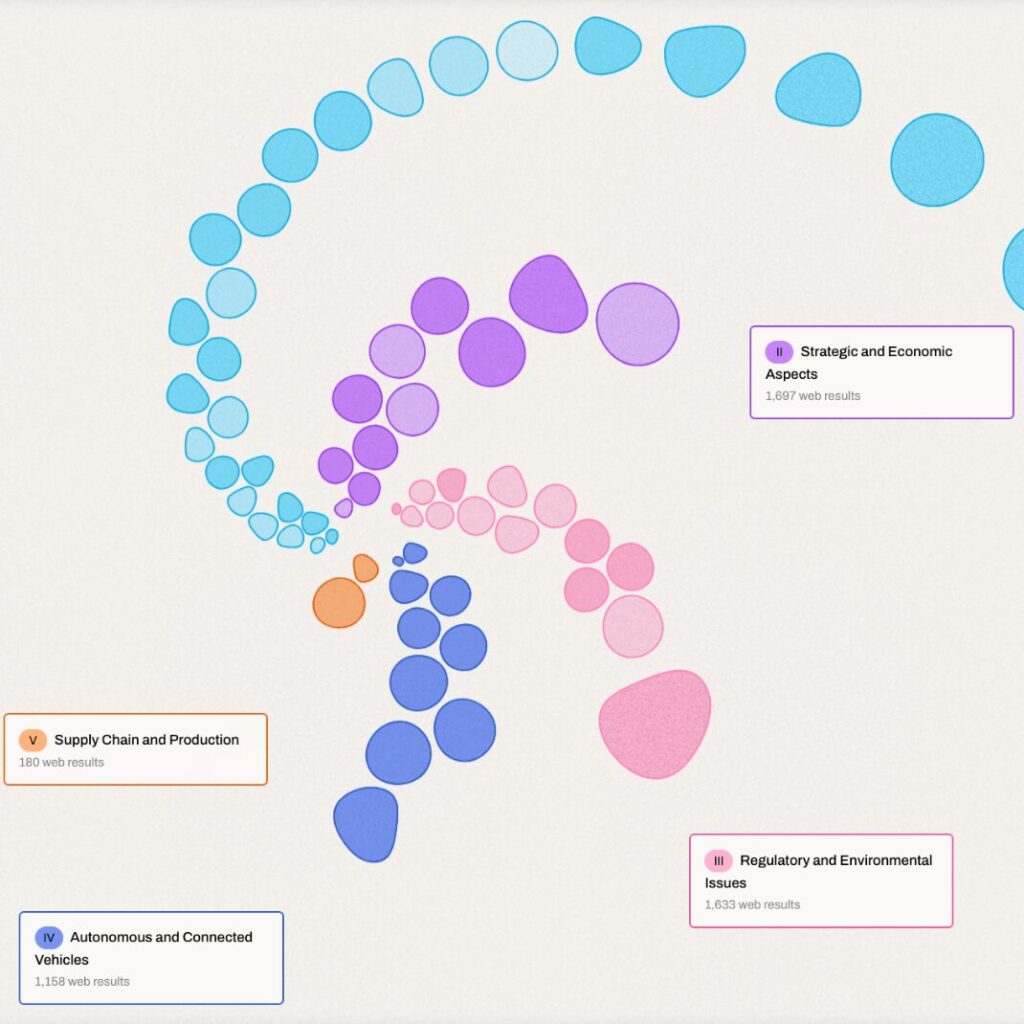
• A bubble visualization (mind map), organized by major themes.
• A synthetic report generated by artificial intelligence, with a table of contents for selecting points to explore in greater depth.
• A database containing the raw data collected on the Internet, structured by key points.
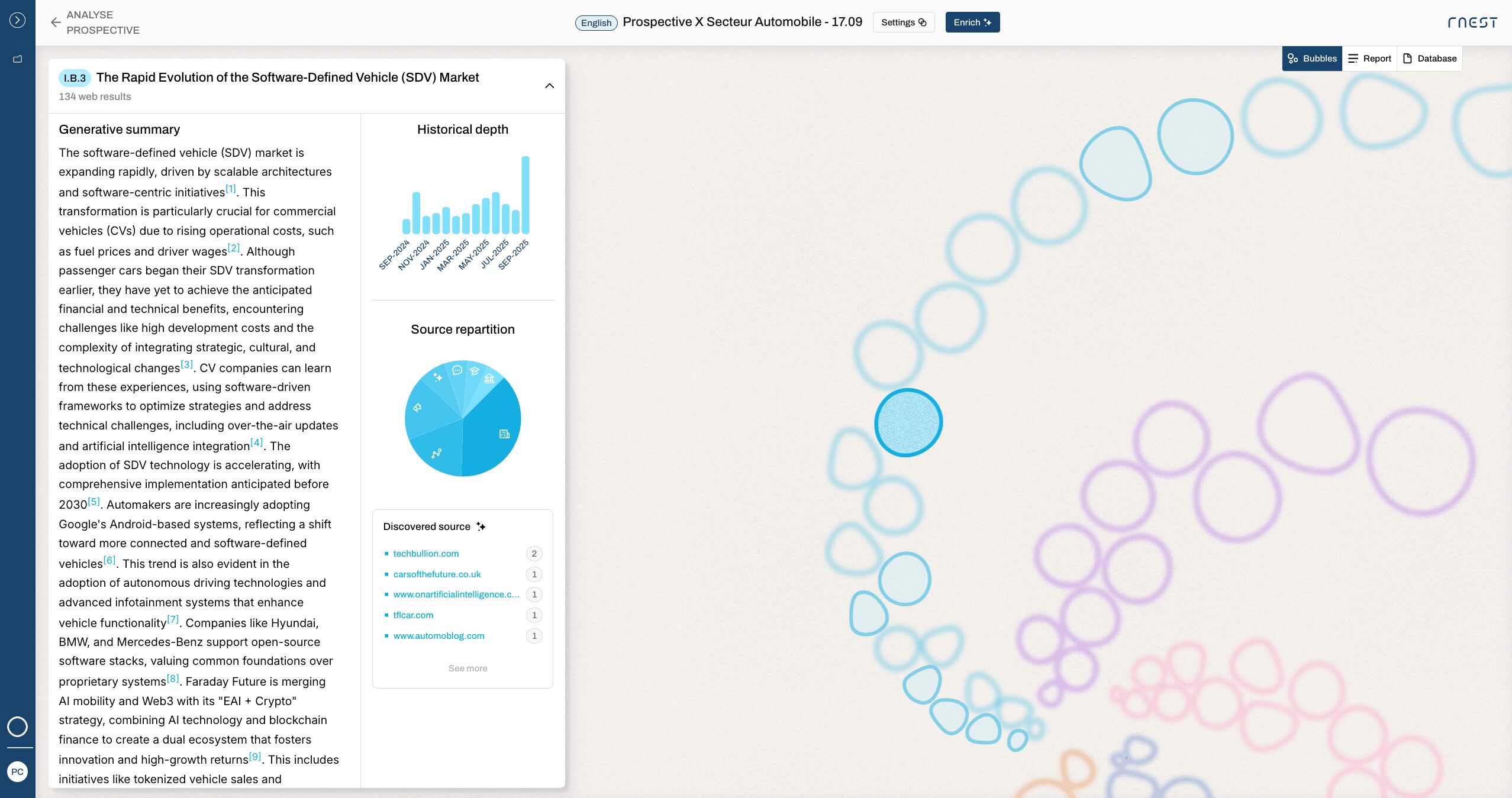
Each key point is based on the cross-checking of several information sources, directly accessible in the Rnest interface. Users therefore experience a fully explainable AI based on independent sources.
To strengthen the collaborative dimension, users can export their results (docx or csv) to manipulate and share them in their own working environments.
Users can scan the key points raised by Rnest in just a few minutes, in three forms:
• A bubble visualization (mind map), organized by major themes.
• A synthetic report generated by artificial intelligence, with a table of contents for selecting points to explore in greater depth.
• A database containing the raw data collected on the Internet, structured by key points.
Each key point is based on the cross-checking of several information sources, directly accessible in the Rnest interface. Users therefore experience a fully explainable AI based on independent sources.
To strengthen the collaborative dimension, users can export their results (docx or csv) to manipulate and share them in their own working environments.
Over the course of 14 months, Numendo delivered a state-of-the-art technological solution, providing technical recommendations that anticipated the future evolution of the platform. The inherent complexities of such a project were handled with great intelligence as the execution progressed. We would like to thank the entire team for their commitment and added value—especially Elliot, whose leadership, creativity, and technical rigor played a key role in this success.
Results and benefits
The launch of the SaaS software had a significant impact, both in terms of user experience and client value.
• Response to users’ demand for automated analysis: Rnest meets the expectations expressed by users of the first POC.
• Stronger adoption: an accessible and intuitive tool that can be used by a broad audience.
• Increased autonomy for internal teams: successful knowledge transfer, enabling La mètis to handle maintenance and developments without external dependency.
• Enhanced strategic offering: La mètis clients are requesting access to the SaaS offering, on segments that complement the white notes produced by La mètis’ team members.
• International reach: thanks to multilingual support and the management of diverse sources, the tool meets the needs of a global client base.
• Response to users’ demand for automated analysis: Rnest meets the expectations expressed by users of the first POC.
• Stronger adoption: an accessible and intuitive tool that can be used by a broad audience.
• Increased autonomy for internal teams: successful knowledge transfer, enabling La mètis to handle maintenance and developments without external dependency.
• Enhanced strategic offering: La mètis clients are requesting access to the SaaS offering, on segments that complement the white notes produced by La mètis’ team members.
• International reach: thanks to multilingual support and the management of diverse sources, the tool meets the needs of a global client base.
impact
The Rnest project illustrates Numendo’s ability to support clients in transforming complex technologies into concrete, ergonomic, and accessible solutions. Through close co-construction combining technical expertise and UX sensitivity, La mètis now has a modern, collaborative, and multilingual SaaS platform that strengthens the value of its strategic offering and increases the impact of its missions for clients.