Today, with more than 87% of French people using a smartphone, companies no longer have a choice: to succeed, they have to be present on mobile. But creating a mobile app is not enough. It is essential to design an intuitive user interface and a smooth user experience in order to meet users’ expectations. Without that, they will not hesitate to turn to your competitors! In this article, we explore how UX (user experience) and UI (user interface) can make all the difference in guaranteeing the success of your mobile app.
UX / UI: what are we talking about?
You have probably already heard of UX and UI, which stand for user experience and user interface. These two notions are often conflated, even though they are distinct. The confusion is all the more common because they are recent as disciplines in their own right.
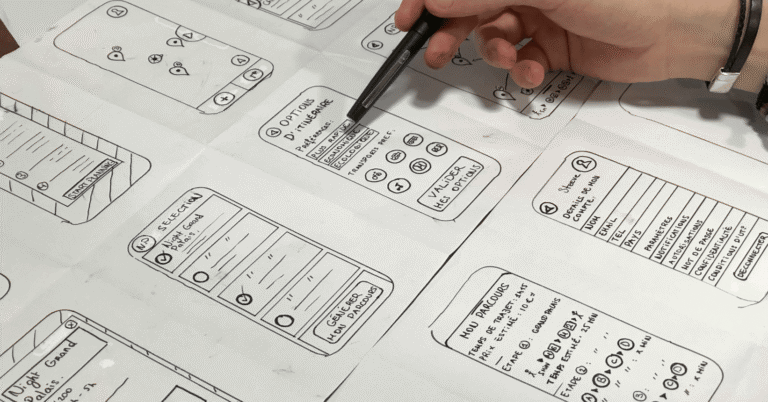
UX (user experience) focuses above all on the way the user interacts with the app. How satisfied are they with the tool? Are they comfortable navigating it? Can they complete tasks easily and effortlessly? The objective is to make the user’s experience as smooth as possible, by anticipating their expectations and reducing complexity in navigation.
Unlike UX, UI (user interface) concerns the visual appearance of the app.
Many factors influence the user’s experience:
- Colours
- Typography
- Content: UX writing
- Icons
- Layout of elements
The objective of UI is to create an attractive interface that guides the user through their interaction with the app.
Be careful, though, to keep your app easy to get to grips with! A good interface must be visually consistent with the app’s identity while offering intuitive navigation.
So, as you will have understood, UX and UI are closely linked concepts. They must be part of the process when developing a mobile app. At Numendo, our UX and UI teams work closely together to design optimised apps and deliver the best possible experience to your users. So let us look at how UX/UI can boost the success of your mobile app.
Why is UI/UX so important for your mobile app?
In a market saturated with mobile apps, offering a quality user experience is an undeniable asset for standing out.
A well-considered UI/UX brings concrete benefits:
- Loyalty: users come back more readily to an app that is pleasant to use.
- Fewer drop-offs: smooth navigation reduces the risk of the user leaving the app part-way through, particularly during a purchase.
- More conversions: when the experience is positive, users are more inclined to complete their actions, whether purchases or sign-ups.
- A stronger brand image: a well-designed app reflects positively on the company behind it.
Our advice on how UX/UI can boost the success of your mobile app
The quality of the user experience (UX) on a mobile app rests on several fundamental criteria: ease of use, smooth navigation, button placement, and so on. As we mentioned above, a well-designed app must keep users interested. Otherwise, they will not hesitate to uninstall the app and look for a more intuitive alternative. So here is some advice to make your app high-performing, pleasant to use and aligned with your users’ expectations.
Simplify authentication
💡 Did you know? 66% of users leave an app when the authentication process is too complex (1). It is therefore crucial to offer fast, intuitive solutions right from the app’s design stage.
Requiring users to enter overly complex passwords can put them off from their very first interaction.
Conversely, modern authentication methods such as Touch ID, Face ID or two-factor authentication offer optimal security while guaranteeing a smooth user experience.
Put a loader or progress bar in place to keep your users patient
How quickly your app loads is crucial, because on average users will not wait more than 3 seconds.
When load time is unavoidable, it is better to display a loader or a progress bar to indicate that the app is working in the background. Providing clear information, such as a progress percentage, allows the user to understand how loading is progressing and to wait more calmly.
Simplify menus and navigation
Unlike websites, where menu bars are often at the top of the page, mobile apps must adapt to touch interactions and one-handed use. To that end, it is essential to make the main features quickly accessible, without forcing the user to navigate through several levels of menus.
Our advice: a fixed navigation bar with a menu at the bottom and clear icons. Interactive elements are placed in the lower area of the screen so that they are easily accessible without having to reposition the hand.
Take the example of a messaging app such as WhatsApp. The menu, which is very simple, displays only four icons at the bottom (Chats, Status, Calls, Settings). This clear organisation allows for fast, intuitive navigation, without an overload of unnecessary information.
Optimise the display for mobile screens
Adapt your interface to different screen sizes and resolutions. Make sure the content is legible and well organised, whatever device is being used. Also remember to include a responsive mode so that the app adjusts automatically according to the type of smartphone or tablet.
Test your app regularly
The best way to improve the user experience is to test the app regularly with real users. Gather feedback on the points that cause problems and adjust accordingly. No theory can replace users’ direct opinions and experience!
Numendo, your partner for a successful mobile app
At Numendo, we understand the importance of how UX/UI can boost the success of your mobile app. As specialists in web and mobile development, we put all our expertise at your disposal to create solutions that are high-performing and pleasant to use. Find out more about Charly, UX/UI designer at Numendo since 2022!
Whether you need to develop a new app or improve an existing project, our team of Product Owners, developers and UI/UX designers supports you from A to Z. We are committed to creating user experiences that build customer loyalty, strengthen your brand and boost your performance.
Get in touch with us now to see how Numendo can turn your mobile project into a success.