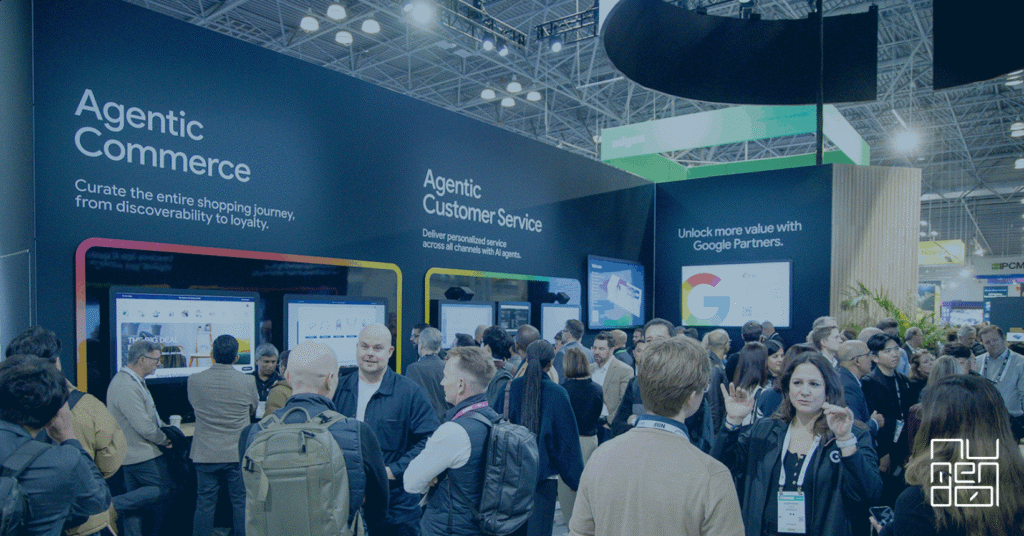
In our previous articles, we explained that agentic commerce was not a simple evolution of UX, but a paradigm shift. At NRF 2026 in New York, our e-commerce partner Shopify turned that vision into concrete infrastructure. With AI-driven shopping traffic up 900% in a year, the question is no longer whether agents are going to buy, but how your technical stack is going to respond to them.
1. The UCP (Universal Commerce Protocol): standardising transactional exchange
At the heart of the announcement is the Universal Commerce Protocol (UCP), developed by Google and endorsed by the biggest names in e-commerce and payments. Where the HTTP protocol enabled the exchange of information, the UCP is designed for the exchange of transactions between autonomous entities.
An architecture of standardised functions
The UCP does not merely transmit data; it exposes transactional capabilities that LLMs can invoke deterministically:
search_catalog: unlike traditional RSS or XML feeds, this function allows agents to query the catalogue using semantic vectors. The agent is not looking for a keyword, but for a solution to a complex intent (e.g. “a hard-shell cabin bag for Miami”).create_checkout&update_checkout: these functions allow the agent to build a basket in real time, including dynamic calculations of taxes and shipping costs and the application of loyalty discounts.complete_checkout: this is the closing stage, where the agent, acting on behalf of the human, validates the transaction through a secure channel.
Why is this a break with the past for integrators?
Previously, integrating a brand onto a new AI platform required bespoke development. With the UCP, a single implementation makes you compatible with every agent that supports the standard (Google, Microsoft, OpenAI and more than 20 other platforms that are already partners).
2. Agentic Storefronts: unifying AI channels
Shopify is now rolling out Agentic Storefronts, an interface that allows merchants to manage their presence on LLMs just as they would for a conventional sales channel (Online Store, POS, Shop).
Technical comparison of 2026 integrations
| Feature | Google AI Mode & Gemini | Microsoft Copilot | ChatGPT Instant Checkout |
|---|---|---|---|
| Technology | UCP protocol | Shopify Checkout Kit | Native Shopify Checkout |
| Fees | No additional fees | No additional fees | 4% transaction fee |
| Availability | End of January 2026 | January 2026 | Immediate (selective) |
| Payment | All processors | All processors | Shopify Payments required |
This granularity is strategic: it allows the merchant to remain the “merchant of record” (the official seller) while delegating the customer interface to the AI.
3. The Agentic Plan: the Shopify catalogue as a service (CaaS)
This is probably the most “expert” aspect of the announcement: opening up the Shopify Catalog to brands that do not run on Shopify.
For a brand using a legacy platform (Salesforce, SAP, etc.), integrating directly with AI agents is technically heavy going. The Agentic Plan makes it possible to use Shopify purely as an abstraction and syndication layer.
- LLM-based enrichment: Shopify uses proprietary language models to “clean up” and structure incoming product data.
- Real-time synchronisation: products are pushed into the catalogue once and synchronised instantly to all AI partners.
4. Numendo’s expertise: your strategic partner through the IRO method
The success of an agentic strategy does not depend on the AI itself, but on the quality of the IT architecture and of structured data. As an expert Shopify integrator, Numendo works on the critical friction points of this new infrastructure through our IRO approach (Imagine, Realise, Optimise).
Imagine: IT consulting and strategy
We audit your digital ecosystem to define your “AI-ready” roadmap.
- Architecture audit: can your current IT system respond to the UCP’s asynchronous calls?
- Strategic decision-making: choosing channels (UCP vs direct) according to your margins and your current tools.
Realise: engineering and data structuring
We implement the essential technical foundations.
- Normalising attributes (data readiness): we enrich your product metadata so that it can be interpreted perfectly by reasoning engines such as Google’s or OpenAI’s.
- Managing complex transactional flows: configuring shipping and tax APIs so that your business rules are respected 100% in every chat. Handling a checkout inside a chat requires perfect configuration of the shipping and tax APIs. We configure your Agentic Storefronts so that your brand’s business rules are respected 100%, while guaranteeing minimal friction for the end user.
Optimise: performance and scalability
Agentic commerce is constantly evolving, and as things stand we are only at the beginning of this new era.
- Monitoring and deployment: although these functions are only available in the US for now, we are preparing your IT system for the imminent European expansion.
- Continuous improvement: adjusting “AI-first” distribution according to agents’ actual performance.
Conclusion: prepare your architecture for Europe
Although these functions are being launched in the USA first, regional expansion is imminent. Waiting for the European rollout before adapting your infrastructure would be a strategic mistake. Commerce is no longer a destination; it is a capability embedded in every conversation.
Want to get ahead of the competition?
Book a meeting with our Numendo consultants for a strategic analysis of your IT architecture and your catalogue.