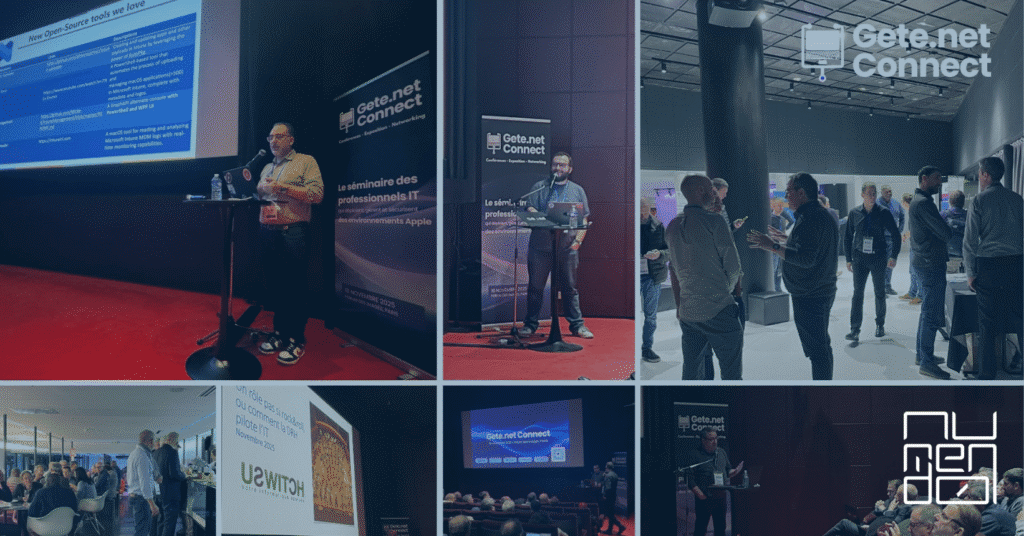
At the end of 2025, Numendo took part in Gete.net Connect 2025, the benchmark French event dedicated to Apple administration in the enterprise. Between major innovations in Microsoft Intune, a drastic strengthening of macOS security and the optimisation of network infrastructure, this 2025 edition marked a decisive milestone: the Mac is no longer a satellite of the information system, it is becoming a first-class citizen of it.
For our clients, the challenge no longer lies solely in managing a fleet of devices, but in the ability to make the elegance of the Apple experience talk natively to the power of Microsoft’s security frameworks. Here is our strategic analysis of the trends that will shape your IT in 2026.
1. Microsoft Intune: “Day-Zero” as a governance standard
The headline announcement from Marc Nahum (Microsoft) was unequivocal: Microsoft is massively accelerating its support for Apple environments.
- Absolute responsiveness: with “Day-Zero” support for macOS Tahoe and iOS 26, companies will be able to deploy the latest Apple updates as soon as they are released, without compromising Intune management.
- Risk-driven security: the integration of the Defender Risk Score for macOS into Intune compliance rules now makes it possible to condition access to company data on the actual threat level detected on the device.
- Life-cycle automation: adopting declarative management (DDM) for applications allows devices to self-regulate and bring themselves back into compliance autonomously.
2. Platform SSO: single identity, a pillar of Zero Trust
The password is living its final hours. Platform SSO is establishing itself as the keystone of the modern user experience.
By combining Apple’s and Microsoft’s capabilities (via Authenticator and Entra ID), employees use their company credentials to unlock their Mac and instantly access their cloud resources without friction. The use of passkeys (FIDO2) via QR code simplifies not only the daily session, but also the initial onboarding of the device (Setup Assistant), while guaranteeing an impregnable level of security thanks to Apple’s Secure Enclave.
3. Multi-layered security: the anatomy of macOS — defining the layers in order to secure them better
One of the most striking sessions, led by Damien Gosset (Apple-accredited trainer), made it possible to revisit the macOS security architecture from the ground up. For our technicians, this educational reminder was essential: before tackling complexity, you first have to define precisely what you are protecting.
- A tree structure: the speaker first presented and defined each layer of the system. It starts with the hardware foundation (Apple Silicon, Secure Boot, Secure Enclave) and works up to the software protection mechanisms at the execution engine, such as XProtect and the Endpoint Security Framework.
- The 2026 admin strategy: once these layers have been identified, the challenge for the administrator is knowing how to call on them. The strategy we recommend consists of coupling these native building blocks with conditional access mechanisms, strict compliance policies, and remediation tools such as Jamf Protect or Microsoft Defender.
4. Network infrastructure: beyond “marketing” Wi-Fi
All too often neglected, the network is the sinews of war. Philippe Astier reminded us that performance depends on compliance with standards rather than on commercial promises.
- Compliance with the IEEE standard: unlike purely commercial labels, Apple rigorously follows the IEEE’s requirements (802.11).
- The notion of “airtime”: each device monopolises a speaking slot in order to transmit its data. Understanding how airtime works is crucial in order to avoid saturating the network.
- Audit and standards: the importance of carrying out prior coverage studies is paramount. Adopting 5 GHz / 6 GHz and WPA3 with a certificate (EAP-TLS) via MDM is now a prerequisite for mobile productivity.
5. Swift Dialog: the interface serving user autonomy
One of the major challenges of the Digital Workplace is to reduce the number of actions required from support technicians while improving the employee experience. This is where Swift Dialog comes in, a tool based on the Apple language that makes it possible to build elegant and intuitive graphical interfaces.
- “Zero Touch” deployment achieved: imagine an employee receiving their new Mac directly at home. They connect it to their router, and then a dedicated interface takes over.
- Transparent guidance: thanks to tools such as Setup Manager, Swift Dialog guides the user in a completely autonomous way. The interface explains in real time what the system is configuring (software installation, security settings, certificates).
- Result: users gain autonomy, understand what is happening on their machine, and IT teams see their volume of onboarding tickets fall drastically.
The Numendo expert’s view: anticipating in order to bring things together better
Numendo’s participation in GETE.CONNECT 2025 confirms our vision: a high-performing Digital Workplace is one that does not have to choose between its ecosystems.
We are already preparing our clients for these developments:
- Wi-Fi audit and modernisation to accommodate the Wi-Fi 6E/7 traffic of the new Macs.
- Deployment of Platform SSO to remove identity silos.
- Intune/macOS convergence to centralise the governance of Apple devices within your existing Microsoft tenant.
An excellent user experience on Mac is not a matter of chance. It is the result of a well-thought-out architecture, built-in security and perfectly orchestrated tools.
Does your company run Macs in a Microsoft world? Our experts are at your disposal to align your infrastructure with the standards of 2026.
Tool focus: the modern Mac admin’s glovebox
The event also validated the widespread adoption of solutions that make administrators’ day-to-day work more reliable:
- SwiftDialog & SwiftUI: to create professional and smooth onboarding interfaces.
- Setup Manager & Setup Checklist: for a genuinely accomplished “Zero Touch” deployment.
- Python automation & PRTG: for proactive, automated monitoring of the fleet’s state of health.