Integrating generative and analytical artificial intelligence is no longer limited to simply improving software productivity. For the Product Designer, it marks a fundamental transition: the move from a role of interface executor to that of strategist and pilot of complex systems. This transformation is redefining the boundaries between design, user research and the maintenance of design systems.
The evolution of the role: from pixels to strategic steering
AI is redistributing added value across a product’s lifecycle. Traditionally, a significant share of design time was devoted to repetitive or compliance-related tasks. Today, automating those processes makes it possible to shift the focus towards conceptual thinking.
The designer does not disappear behind the algorithm; they become the guarantor of meaning and quality. Their mission is to assemble, bring coherence to and validate the outputs provided by AI. This “pilot” role requires a detailed understanding of what the models can do in order to turn a strategic intention into a tangible result with maximum impact.
Tool interoperability: the Gemini Pro 3 and Figma case
One of the major advances lies in creating dynamic bridges between Large Language Models (LLMs) and design tools. Using Gemini Pro 3 within environments such as Figma Make illustrates this synergy.
Automating design systems
AI is now able to learn from the specific structure of a working file or an existing design system. This capacity for contextual ingestion makes it possible to automatically generate component variants or entire pages while scrupulously respecting the constraints that have been set.
This efficiency does, however, rest on a strict technical prerequisite: the quality of the source data. To be relevant, AI requires rigorously structured files. The standardisation effort therefore becomes the designer’s priority investment in order to unlock the power of automation.
Optimising accessibility and technical documentation
The traditional approach to accessibility often relies on manual tests or limited static plugins. AI introduces a contextual and educational dimension.
By analysing video streams or screenshots, computer vision models can now identify breaches of accessibility criteria. Beyond simple diagnosis, AI suggests corrective solutions that incorporate brand requirements. This ability to explain in detail turns quality control into a process of continuous learning for the teams.
In the same way, component documentation — often perceived as a low value-added task — is automated through visual and structural analysis. The designer provides the outline, and the LLM takes care of the descriptive technical writing, ensuring documentary consistency across the whole project.
User research in the age of semantic analysis
Processing qualitative data used to represent a major bottleneck in UX research. LLMs make it possible to remove that obstacle by processing large volumes of interviews and open-ended questionnaires.
From audio to strategic verbatim
The workflow is being modernised: audio capture, automated text transcription, then semantic analysis by the LLM. The tool does not merely summarise; it identifies recurring patterns, extracts significant verbatim quotes and prioritises user needs. This processing capability makes it possible to run studies at a scale previously reserved for quantitative methods, without losing the depth of qualitative work.
Simulating panels: AI as a proxy user
An emerging practice consists of using AI to simulate personas and test navigation hypotheses. By configuring specific prompts, the designer can confront their interface with cognitive biases or particular user profiles.
While this method offers unprecedented agility for rapid prototyping, it calls for methodological caution. AI simulates behaviours based on statistical probabilities; it does not replace the unpredictability and the truth of the field. It should be seen as a pre-validation tool that makes it possible to refine a concept before submitting it to a human panel.
The emergence of AI agents and operational autonomy
The current stage goes beyond the simple static script to reach that of AI agents. Unlike a classic algorithm, an agent perceives its environment and adjusts its actions according to an end goal.
In the context of Product Design, these agents can be deployed to autonomously aggregate feedback from heterogeneous sources (customer support, surveys, social media). By generating weekly trend reports, they allow product teams to prioritise the roadmap dynamically, based on real-time analysis of emerging needs.
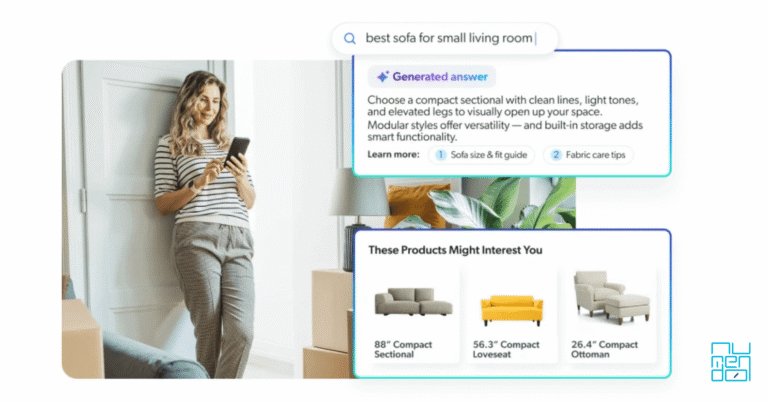
This rise in autonomy is already transforming entire sectors, as we analysed with the emergence of Agentic Shopping, the new frontier of e-commerce.
Feedback from Charly B., Product Designer at Numendo
On a day-to-day basis, integrating AI is profoundly changing the way I approach certain key phases of my projects. Here are three concrete areas where using these tools is transforming my practice:
AI as a strategic assistant when preparing workshops.
Organising user workshops is often time-consuming. Today I use LLMs as genuine preparation assistants to structure my action plans. By giving the model the workshop’s context and objectives, AI helps me select the most relevant format and generate the necessary document templates. It also proves very effective at refining the recruitment phase by defining the target user sample, and at drafting interview guides with sharper questions directly linked to the project’s stakes.
Augmented accessibility diagnosis.
Accessibility checking is moving out of the purely technical sphere to become more educational. Where a classic plugin simply flags an error, AI allows me to go much further. By sending a simple screenshot or a video of my mock-ups, I get a detailed analysis of compliance criteria. What is particularly interesting is its ability to suggest concrete fixes that respect the brand’s visual identity. You no longer receive just an alert, but a documented explanation of where the problem comes from and how to resolve it.
Intelligent automation via AI agents: a new horizon.
Beyond today’s tools, we are entering the era of “AI agents”. Unlike static scripts, these agents have the ability to perceive an environment and adjust their actions in order to reach a goal. I am already envisaging using these agents to revolutionise the management of repetitive tasks and the analysis of massive data sets.
For example, it is now entirely conceivable to configure an agent responsible for continuously aggregating user feedback (customer support, surveys, social media). By analysing that data to generate weekly trend reports, such a setup would make it possible to steer the roadmap with unprecedented responsiveness. That is where the near future lies: AI no longer merely executes, it becomes a sentinel that allows the designer to focus on what matters most — continuously improving the user experience.
Conclusion: a new agility, on condition of curiosity
AI is not a miracle tool, but a catalyst for efficiency. It requires Product Designers to keep a constant watch on developments and to adapt their technical skills. The time saved on repetitive tasks must be reinvested in thinking, ethics and product strategy. Ultimately, a product’s performance will no longer depend solely on the quality of its interface, but on the designer’s ability to orchestrate artificial intelligence in the service of a coherent, accessible human experience.
This new era of agentic commerce, the new era of AI-orchestrated shopping, perfectly illustrates this transformation, where the shopping experience itself also becomes orchestrated by AI.