E-commerce has already been through several revolutions: the democratisation of marketplaces, the arrival of headless architectures, and then the rise of generative AI to produce content and visuals.
The next disruption is under way: agentic commerce. An approach in which a purchase is no longer initiated by the user via a website or an app, but delegated to an autonomous AI agent capable of understanding a need, exploring the available offers, comparing them, and executing the transaction.
What is agentic commerce?
An AI agent does not merely generate text or an image: it acts.
Where generative AIs such as ChatGPT or Gemini produce content, an agent combines these capabilities with:
- an operational memory (retaining interactions over several days),
- access to third-party services beyond the web (product catalogues, PIM/DAM, ERP, CRM),
- and the ability to execute transactional actions (payment, booking, logistics).
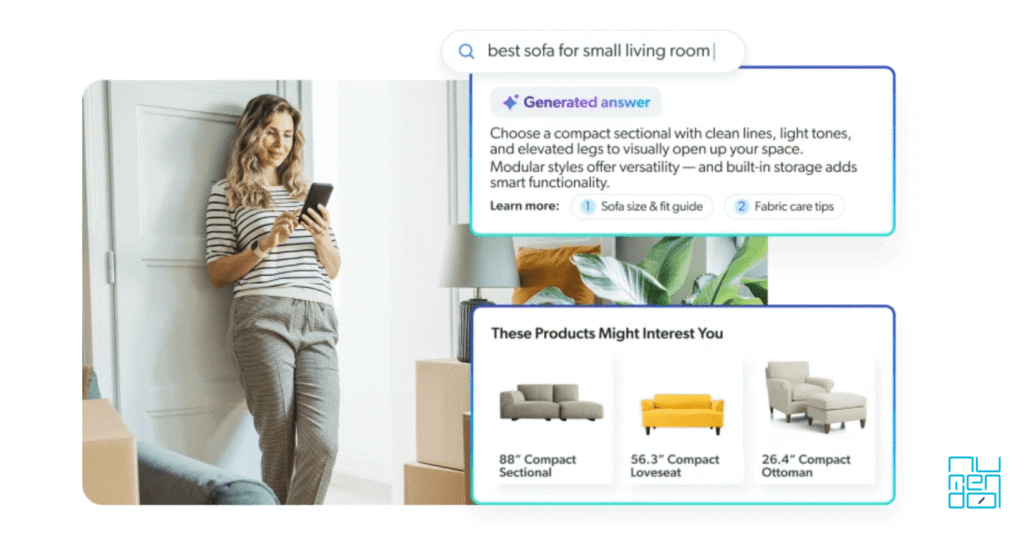
For example: you ask an agent to “find a pair of white trainers delivered before Friday, budget €120”.
It queries the catalogues, checks lead times, compares prices, proposes two options and can finalise the purchase via a secure protocol.
A profound paradigm shift: the customer no longer interacts with the shop, but with their trusted agent.



Product data: the crux of the matter that is transforming the shopping of tomorrow
In this model, product data quality becomes critical. An agent can only interpret what is structured and standardised:
- An incomplete product sheet = an invisible product.
- An inconsistent taxonomy = a biased comparison.
- Approximate SEO = a product ignored by search engines and agents alike.
Hence the importance of emerging standards such as FAB-DIS (interoperability of manufacturer ↔ distributor data) or solutions such as Mirakl Nexus, which harness AI to automate data distribution and quality across PIM/ERP systems.
At Numendo, we already support our clients with product data governance: enrichment, taxonomies, omnichannel integrations.
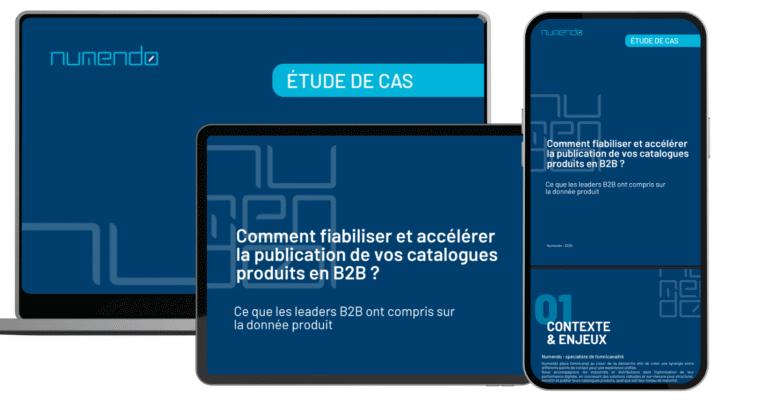
Our white paper on how to make B2B product catalogue publication more reliable and faster is available free of charge here: White Paper – Making your B2B product catalogues reliable.
The technology building blocks: from ChatGPT Operator to Google AP2
Agentic commerce relies on an ecosystem that is still being built.
- LLM + Operator (OpenAI, Gemini, etc.): to orchestrate complex actions (searching, comparing, booking).
- Plugins / connectors (PIM, CRM, ERP): to give agents reliable access to catalogues and business data.
- Automated payment protocols: the Google Agent Payments Protocol (AP2) is a major step forward.
AP2 allows an agent to initiate a payment securely, with interoperability and mandatory human validation. It is probably the link that has been missing until now: without payment, there is no agentic transaction.
The challenges of agentic commerce
Despite the potential, several limitations are still holding back mass adoption:
- Trust and transparency: the user must be certain that the agent is acting in their interest (and not in favour of a preferred merchant).
- Payment security: even with AP2, reassurance remains key.
- Quality of generated content: even today, AI-produced product sheets and descriptions require human proofreading.
- Social acceptance: fully delegating a purchase to an AI remains difficult, especially for less digitally native generations.
- The emotional factor: an agent can handle the household shopping or train tickets, but will struggle to choose a fashion accessory for an event.
Outlook: towards gradual adoption of agentic shopping
The adoption of agentic commerce will not happen in a single step, but in successive layers, as consumer trust grows and technical standards take hold.
- Recurring, standardised purchases. The first use cases will involve everyday products: household shopping, consumables, subscription replenishment. Simple, predictable, low-emotion needs, perfectly suited to automation.
- Enhanced assistance along the customer journey. Gradually, agents will act as digital concierges: filtering catalogues, comparing complex options, answering in natural language. The user retains control over the final decision but delegates the tedious research.
- Autonomous transactions with human validation. Thanks to protocols such as Google AP2, agents will be able to carry out transactions end to end, with quick validation by a human. This hybrid model (AI + user control) should form the core of agentic commerce in the coming years.
- Partial automation of B2B. In a second phase, B2B will fully benefit from these technologies: automated management of supplier catalogues, placing of recurring orders, reconciliation of product data. These are processes that are often high-volume, standardised and low-emotion — ideal for agentic approaches.
In the medium term, the companies that have invested in structuring their product data, in the interoperability of their systems and in agentic experimentation (PoCs, API connectors) will naturally be ahead of their competitors, ready to capture the first benefits of these new purchasing behaviours.
Numendo, your partner for entering the agentic AI era
At Numendo, we are convinced that agentic commerce does not represent a passing trend, but a genuine change in the infrastructure of e-commerce.
We already support our clients in anticipating this shift and turning the promise into a concrete competitive advantage:
- Preparing their product data (quality, taxonomies, enrichment, MDM, PIM/DAM integrations, syndication, OMS, WMS, etc.).
- Testing and deploying AI agents connected to existing catalogues and systems.
- Anticipating emerging protocols (Google AP2, FAB-DIS, Mirakl Nexus, etc.) and integrating future standards.
- Designing smooth omnichannel experiences in which the agent is not an opaque filter, but an ally serving both the brand and the customer.
Our mission: to help companies make the transition to intelligent shopping step by step — where AI does not replace people, but amplifies their experience.
Conclusion
Agentic commerce marks a break with the past: consumers are delegating part of their purchasing journey to intelligent agents. Between generative AI, standardised product data and payment protocols such as Google AP2, the technical foundations have already been laid.
The real question is no longer whether, but when.
Companies that start anticipating this shift today will turn the challenge into an opportunity, and position themselves at the heart of tomorrow’s intelligent shopping.