At the AMP Conf held on 17 April 2019 in Tokyo, Google officially announced a solution for displaying the URL of content publishers on AMP pages. That seems only fair — except that it was not the case until now. Here is a little more about this feature, which is still in its infancy.
@AMPhtml (AMP Project), 17 April 2019: “AMP pages are beautiful, but links to AMP pages? Not so much… Until today! Signed exchanges are here: now you can get instant loading for AMP on your own domain! #AMPConf”
(This tweet was embedded in the French version and needs to be re-attached.)
A different URL for AMP pages
Until now, AMP pages were accessible from this type of URL: google.com/amp/thenameofyourpage. For a concrete case, we have chosen to use the same AMP page as an example as in our previous article on the definition of AMP pages. The URL of the AMP page in question is as follows:
A screenshot showed an organic mobile search result for the search term “tiramisu recipe”, the result in question being an AMP page. This image was in the French version and needs to be re-attached.
As you can see, the web address pointing to the content of the hervecuisine.com website is — how shall we put it — very Google-ish! Many people have complained about it, all the more so because Google hosts your content in order to have more effective caching. So if, on top of that, it publishes that content under its own domain name, you might think it was trying to eat the whole cake — or at least the whole tiramisu.
Signed HTTP Exchange: a chain of trust based on a digital signature!
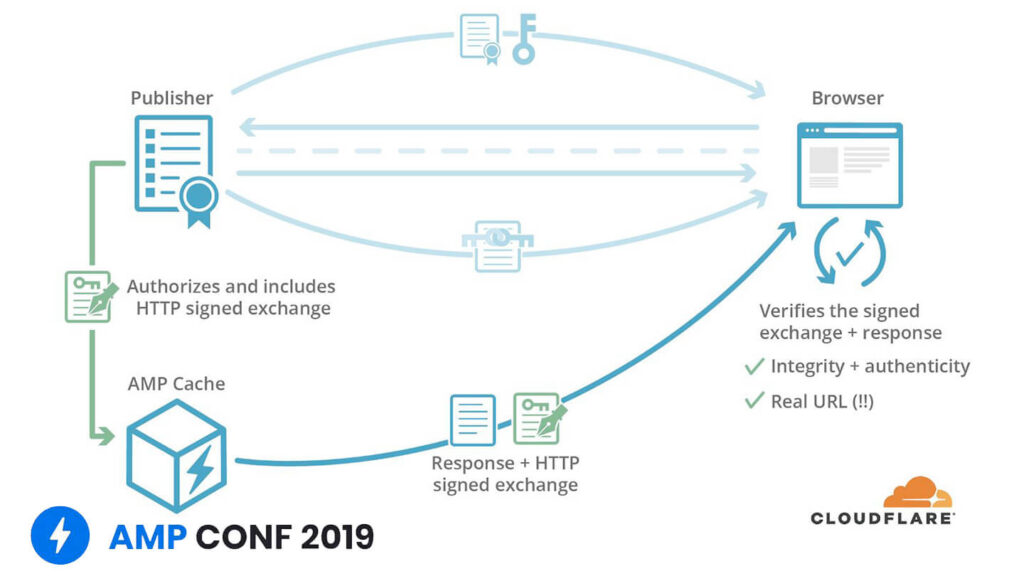
In order to display the domain name of content publishers, Google uses the Signed HTTP Exchange technology. This is a process designed to relay a page’s URL by means of a chain of trust. This relaying is done using a digital signature issued by the site that publishes the content, which then travels between Google’s CDN (the Google servers that cache your content) and the client web browser. In this way, the AMP page delivered allows you to enjoy authenticity over your content. A kind of blockchain, Google-style. In short, it allows you to benefit from the technical advantages of AMP pages while publishing under your own name (and therefore no longer having a Google-ish URL)! As you might expect, it is not possible to appropriate a third party’s domain name that easily — and thankfully so! Google worked for more than a year in order to develop this complex technique. It also set up a partnership with the content delivery and security provider Cloudflare, which published on its website the diagram used by Signed HTTP Exchange. Cloudflare also announced that its customers can already benefit from this feature simply by ticking a small box.
For the time being this feature is still restricted to the Chrome browser for Android. In other words, once it is installed on your site, your articles will take the following form: https://mysite.com/article1/amp. Nevertheless, if you want to find out more, you can consult the guide dedicated to setting up this feature here.