In a constantly evolving e-commerce sector, companies faced with high traffic volumes, thousands of daily orders and the continuous management of new customer accounts have to innovate in order to maintain impeccable service quality. One of the most powerful levers for gaining operational efficiency and smoother execution lies in process automation. Properly mastered, it not only limits human error but also guarantees a personalised, consistent customer experience for truly unified commerce.
The challenges of automation in e-commerce
Large-scale companies face specific challenges:
- Complex operations management: with a high order volume, manual management quickly becomes inefficient and error-prone.
- Personalisation at scale: delivering a personalised customer experience requires tools capable of processing and analysing large quantities of data in real time.
- Integrating multiple systems: large companies often use various systems and platforms that need to be synchronised in order to ensure operational consistency.
Automation addresses these challenges by streamlining processes, reducing human error and freeing up time to focus on higher-value tasks.
Shopify Flow: a high-performing automation solution
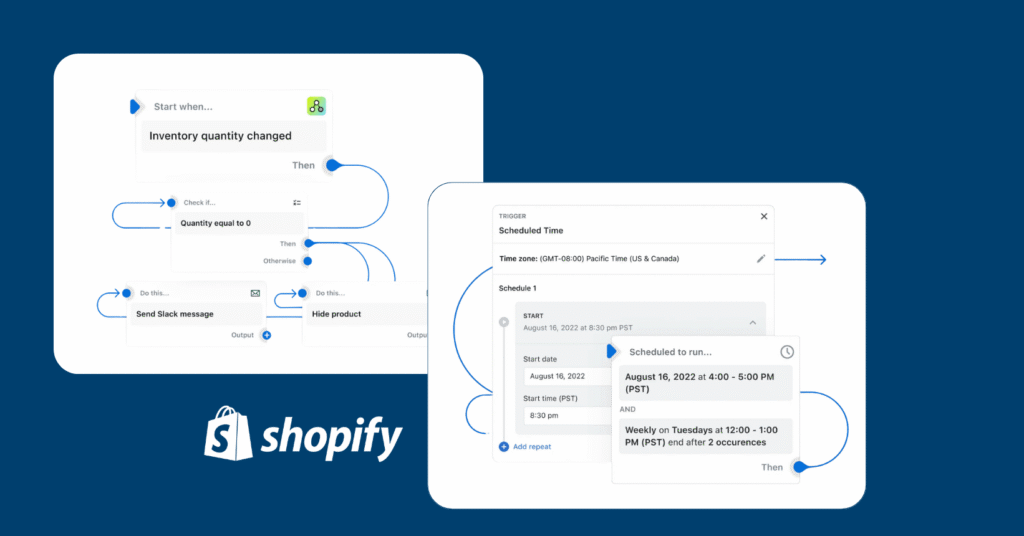
Shopify Flow is an automation tool built into Shopify that allows companies to create custom workflows without needing development skills. It works on the basis of three main components:
- Triggers: events that start the workflow, such as the creation of a new order or the addition of a new customer.
- Conditions: criteria that must be met for the action to take place — for example, if the order value exceeds a certain threshold.
- Actions: automated tasks carried out when the conditions are met, such as sending a thank-you email or updating an order’s status.
Thanks to Shopify Flow, companies can automate tasks such as inventory management, fraud detection, customer segmentation and much more. This not only saves time but also improves the accuracy and consistency of operations.
As a native Shopify tool, Shopify Flow is fully integrated into the platform’s ecosystem. That guarantees perfect scalability, even for companies handling thousands of operations a day, with no slowdowns or technical limitations. Another major advantage: the tool is free, unlike other no-code solutions that can quickly become expensive as automation volumes grow.
Practical automation use cases with Shopify Flow
- Inventory management: automate the updating of stock levels in real time to avoid stock-outs or overstocking. For example, when a product reaches a critical threshold, a replenishment order can be generated automatically.
- Customer segmentation: automatically identify and tag customers according to their purchasing behaviour, making targeted marketing campaigns easier.
- Fraud prevention: set up automatic alerts for suspicious orders, allowing the relevant team to intervene quickly.
Numendo: your Shopify integration partner for successful automation
As an integration agency specialising in Shopify, Numendo supports major French e-commerce companies in setting up bespoke automation solutions. Our expertise allows us to understand the specific challenges faced by companies with more than €20 million in revenue and to propose suitable solutions.
We offer a complete service, from needs analysis to the implementation of automated workflows, including training for your teams. Our aim is to enable you to take full advantage of automation in order to optimise your operations and improve your profitability.
Frequently asked questions
1. What is automation in e-commerce?
Automation in e-commerce consists of using technological tools to carry out repetitive tasks without human intervention. That can include inventory management, sending personalised emails, fraud detection or logistics optimisation.
2. Why automate an e-commerce site?
Automating your e-commerce site saves time, reduces errors, makes operations smoother and improves the customer experience. It is also a way of scaling effectively without adding to your headcount.
3. What are the best tools for automating an e-commerce site?
Well-established solutions include Shopify Flow for Shopify users, but also Klaviyo (email marketing), Gorgias (customer support), and Zapier or Make for connecting different no-code tools. Shopify Flow stands out by being free and directly integrated into the Shopify platform, which makes it particularly well suited to high-volume sites.
4. How does Shopify Flow make it possible to automate an e-commerce business?
Shopify Flow makes it possible to create automated workflows in just a few clicks — for example, triggering an alert in the event of a stock-out, sending an abandoned-basket reminder or automatically segmenting a customer according to their purchasing behaviour.
5. Is automation suitable for large e-commerce brands or pure players?
Yes. Automation is particularly relevant for e-tailers handling a large volume of orders, traffic and customer data. It allows them to maintain a high level of service and optimise their resources.
6. What is the return on investment (ROI) of automation for an e-commerce site?
The ROI can be significant: reduced operating costs, a higher average basket thanks to personalisation, fewer abandoned baskets, improved conversion rates, and so on. It all depends on the scope automated and the strategy in place.
7. How can Numendo support an e-commerce automation project?
Numendo, as an expert Shopify agency, supports companies in setting up bespoke automated workflows: needs audit, definition of automation scenarios, configuration in Shopify Flow, team training and performance monitoring.
Automation has become an essential element for large e-commerce companies wanting to stay competitive in a constantly changing market. Tools such as Shopify Flow offer endless possibilities for streamlining operations, improving the customer experience and increasing profitability. With Numendo’s support, you can integrate these solutions effectively and in a way that is tailored to your specific needs.
Do you have a replatforming project on Shopify, or would you like to create automated workflows? Get in touch to discuss it.